Sharing concepts
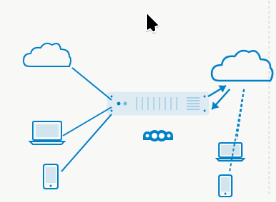
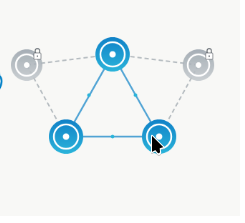
nextcloud compared to syncthing
| nextcloud | syncthing |
|---|---|
 |
 |
| Data always on central server. Local data is supported and fine, but no need to download all data i have access to. |
all data has to be on the system if I want to have access to it (ignore pattern might work, but maybe complicating). |
| Access to data in Webbrowser | No access to data via gui |
| Sharing via weblink | Sharing only to other peers having syncthing installed |
Sharing a la Syncthing
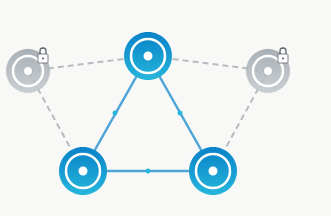
Syncthing shares data peer-to-peer — no central server, no cloud intermediary. Each device communicates directly with the others it knows about.
Syncthing Characteristics
| Property | Detail |
|---|---|
| Peer to peer | Devices sync directly; no server required |
| Self-healing | If a device goes offline, sync resumes automatically when it reconnects |
| Self-discovering | Devices find each other via local discovery and global announce servers |
| Known devices only | Sharing requires explicit trust — only devices you add can participate |
| Known folders only | A folder must be explicitly shared; nothing is exposed by default |
Limitations
- Granularity is limited — you share entire folders, not individual files or sub-trees
- Nesting is not supported — sharing a folder does not share subfolders independently; nested shares cause conflicts and are not recommended
- No per-file access control — all devices with access to a folder see all files in it
Typical currently intended use in this project
This project uses Syncthing across >= 3 nodes: a source (primary), an encrypted backup node, and a hot-spare secondary. All three sync directly
The backup node runs in receive-encrypted mode: it stores only encrypted blobs and cannot read file contents. The secondary holds a full readable mirror and can take over if the source is lost. This shall be granted even if hot-spare was offline via having the ability to receive the latest data from the encrypted backup node.
See Scenario 1 for a concrete setup.
Sharing a la nextcloud

Nextcloud Characteristics
| Property | Detail |
|---|---|
| Central server in the middle | All files reside on the server; accessible via browser or sync client. |
| Web access | Native browser access from anywhere, no client installation required |
| Granular sharing | Files, individual folders, and sub-trees can be shared independently |
| Ad-hoc sharing | A public link grants access to anyone — no account required |
| Federation | Multiple Nextcloud instances can share across server boundaries |
| Access control | Per-item permissions (view, edit, reshare) for users, groups, or public links |
| ### maybe to consider as source of problems |
- relies on server — if the server is offline or unreachable,
- not local synced data is gone /not available
- sync is broken
- Not Peer to Peer and distribution friendly by nature
- all traffic routes through the server, even between devices on the same network
- pinned to DNS or IP, no autodiscovery
- Server-side encryption is an add-on — when enabled, the server cannot index, search, or preview files; key management adds complexity
typical use in this project
| Property | Detail |
|---|---|
| Role | Web access and sharing layer below Syncthing-backed data |
| Deployment | Docker container on the source host; data folder lives inside a Syncthing-synced path |
| Data path | Syncthing replicates the data folder across nodes; Nextcloud provides browser and client access to it |
| Portability | Container/Pod + volume can be migrated to any host; Syncthing restores data independently if needed |
| External sharing | Public links and per-user shares for collaborators outside the node infrastructure |
| Status | first test, apart from the usual caveats like ownership issues. No principal architectonical known obstacles or blockers |
| To check / unclear | does nextcloud keep information about removed data in database(-history ?) forever ?. Especially if removed without using nextcloud |
combining nextcloud and syncthing possible ?
how to keep them going out of their way
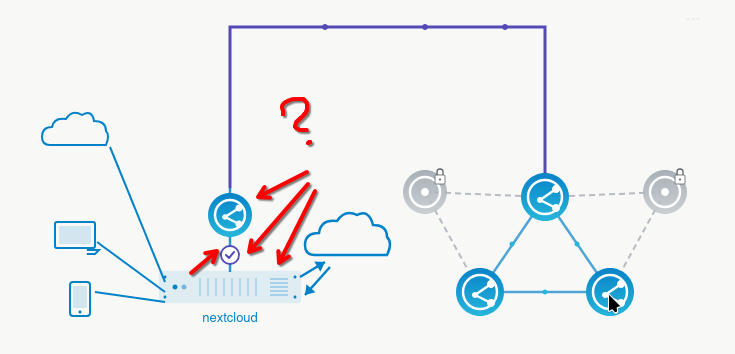
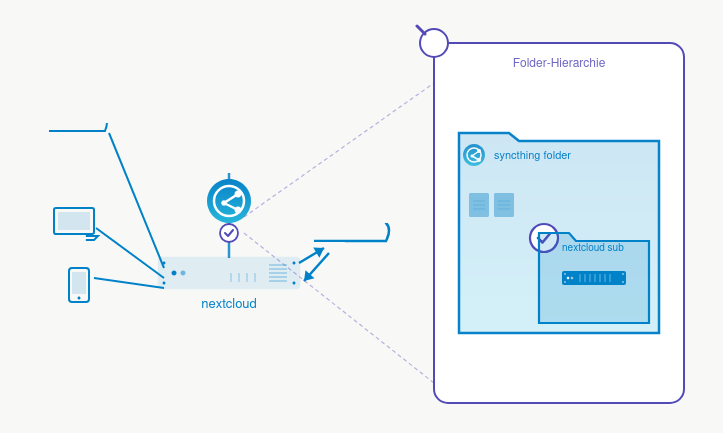
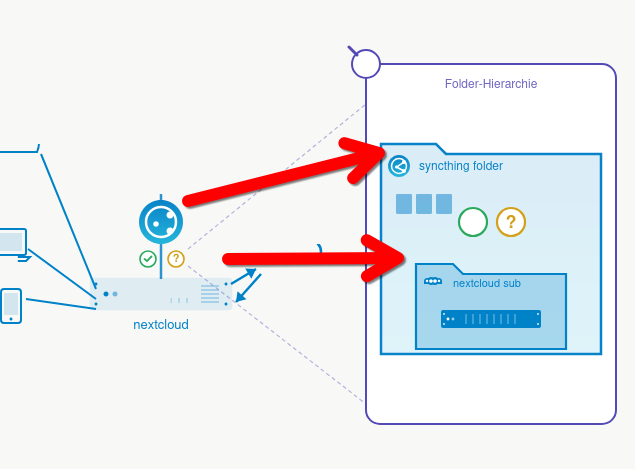
idea: nextcloud starts in subfolder of syncthing-folder
- syncthing treats nextcloud sync data as content
- nextcloud can not reach syncthings status data because its above its folder out of sight and permissions
portability possible ?
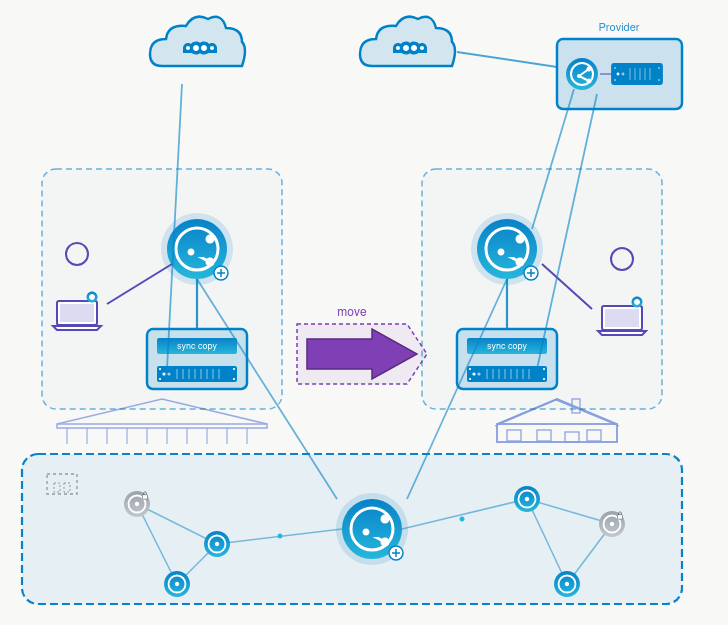
Portability depends on the scenario. The core challenge: Nextcloud share-links and client connections are bound to a domain name. Moving the server breaks them unless the domain moves with it.
| Scenario | Challenge | Mitigation |
|---|---|---|
| Backup / restore | Nextcloud data folder can be replicated by Syncthing; container can be relaunched on a new host | Treat container + data volume as the portable unit — Syncthing ensures the data is already there |
| Person leaves institution or Institution stops or changes service |
Institutional domain disappears; all share-links go dead | Use a portable domain independent of the institution; announce new links before leaving, use some persistent dedicated longterm system |
| Project migrates host | Clients and shares reference the old domain | Pre-announce domain change; keep a redirect proxy at the old address during transition |
| Project forks | ? Splitting one instance means migrating user data and re-issuing all shares | ? If a fork is foreseeable, run independent instances from the start |
- to consider
- nextcloud share-link persistence of
- Sticks to DNS
- mitigations / what to do how instead
- accept staleness or forking
- use use portable DNS
- and nextcloud might support multiple
- transfer snapshots to a longtern dedicated repository of some suitable institution
- see nextcloud -> invenio importer at sciebo ?
- widespread ad-hoc use of zenodo.org
- nextcloud share-link persistence of
← Kube3 Use Case: Projektcloud · Core Concepts →